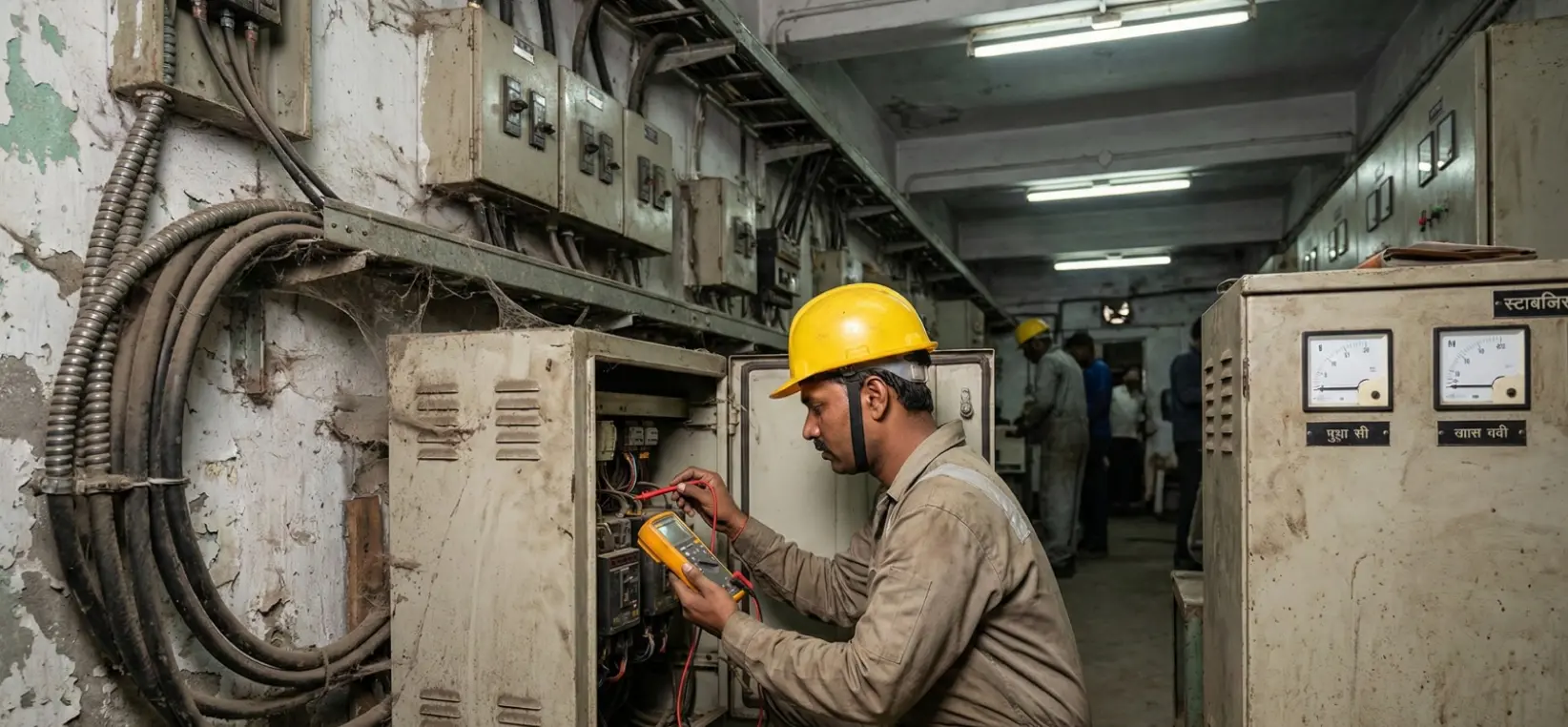
In modern industrial facilities, automation has advanced rapidly. Machines are faster, control systems are more precise, and production tolerances are tighter than ever before. Yet, one foundational challenge has remained stubbornly unresolved across industries and geographies: voltage instability.
Despite significant improvements in power generation and distribution, voltage fluctuations continue to be one of the most underestimated threats to industrial equipment reliability. Their impact is often subtle, cumulative, and therefore overlooked until failure occurs.
The misconception of stable power
Many facilities assume that the presence of a grid connection or backup power source automatically ensures voltage stability. In practice, this assumption rarely holds true. Industrial power systems operate under dynamic conditions: fluctuating loads, starting currents from large motors, unbalanced phases, poor earthing, and upstream disturbances all contribute to instability.
Voltage may remain within nominal limits on average, yet still fluctuate fast enough to stress sensitive equipment. These micro-events rarely trigger alarms but gradually degrade components over time.
How voltage instability affects modern equipment
Today's industrial equipment relies heavily on power electronics, VFDs, PLCs, CNC controllers, servo drives, and automation systems. While these systems enable precision and efficiency, they are also less tolerant of voltage irregularities than traditional electromechanical equipment.
Common long-term effects of unstable voltage include:
- Premature failure of power supplies and control cards
- Increased heating in motors and transformers
- Erratic behavior of automation systems
- Reduced efficiency and higher energy losses
- Unexpected downtime with difficult root-cause diagnosis
These failures are rarely attributed directly to voltage issues, which is why instability remains a silent problem in many plants.
Why the grid alone cannot solve this
Even in regions with relatively strong infrastructure, industrial users experience voltage variation due to factors beyond their control. Load concentration, seasonal demand, renewable energy integration, and long distribution lines all introduce variability.
In developing and rapidly industrializing regions, these challenges are amplified. However, voltage instability is not a regional problem. It is an industrial reality worldwide, particularly in facilities with high dynamic loads.
This is why globally experienced manufacturers design power systems with the assumption that voltage conditions will never be ideal.
The compounding effect over time
One of the most dangerous aspects of voltage instability is its cumulative nature. Equipment rarely fails immediately. Instead, insulation weakens, electronic components age faster, and tolerances drift out of specification.
From a management perspective, this creates a false sense of security. Equipment appears operational until failures cascade, often during peak production periods, leading to costly downtime.
Organizations that track total cost of ownership rather than just acquisition cost consistently find that power quality plays a decisive role in long-term reliability.
Reactive fixes vs engineered solutions
Many facilities respond to voltage issues reactively by replacing failed components, adjusting settings, or installing temporary fixes. While these measures may restore operation, they do not address the underlying cause.
Engineered voltage stabilization, when implemented correctly, acts as a preventive layer. It absorbs fluctuations, corrects imbalances, and ensures that downstream equipment sees stable, predictable power conditions regardless of upstream disturbances.
This approach is not about correcting occasional problems. It is about designing resilience into the power system.
The role of voltage stabilizers in modern plants
Industrial voltage stabilizers, particularly static and fast-response systems, have evolved significantly. They are no longer passive devices but actively controlled systems designed to respond in real time.
When properly selected and integrated, stabilizers:
- Protect critical loads from rapid voltage changes
- Extend equipment life
- Reduce maintenance interventions
- Improve process consistency
- Lower long-term operating costs
The key lies not in the presence of a stabilizer, but in its design philosophy, response characteristics, and suitability for the specific application.
A strategic perspective on power quality
Leading industrial organizations increasingly treat power quality as part of their core reliability strategy. Voltage stability is evaluated alongside redundancy, maintenance planning, and operational risk.
This shift reflects a broader understanding: power quality is not an electrical issue alone. It is a business continuity issue.
Facilities that proactively address voltage instability tend to experience fewer unplanned shutdowns, better asset utilization, and more predictable operations.
Looking ahead
As industrial systems become more automated and interconnected, tolerance for power irregularities will continue to shrink. Future-ready facilities are those that recognize voltage stability not as an optional add-on, but as a foundational requirement.
In the long run, the most successful operations will be those that design their power infrastructure with the same rigor they apply to their production processes.